
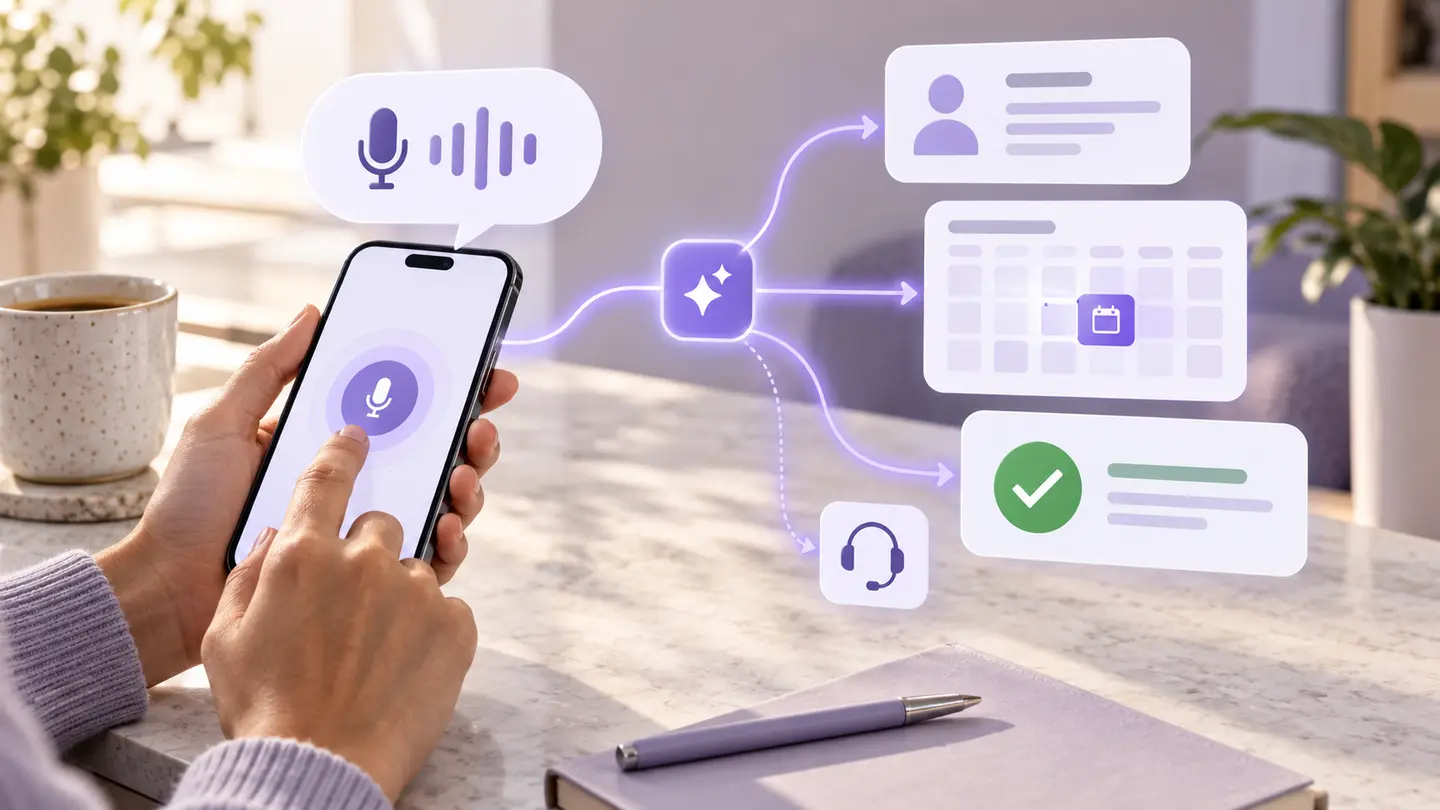
The goal is not automation at any cost. It is the right outcome, within clear permissions, with a person ready to take over.
Is answering questions enough?
Businesses are turning to AI to speed up customer interactions. But there is an important difference between a system that answers a question and one that can help complete a specific task.
A customer might ask to arrange a property viewing. A traditional chatbot could provide general information about viewings. An appropriately configured AI agent could understand the request, collect the necessary details, check appointments through a connected system and help complete the booking within its permissions.
This is where AI agents come in.
What are AI agents?
AI agents are systems that use artificial intelligence to understand goals, determine suitable steps and use available tools or systems to carry out specific tasks, within the permissions and instructions they have been given.
In customer experience, these agents can be designed to handle enquiries, collect information, support bookings or direct requests to the right team.
Capabilities vary between systems. Some agents only answer questions; others can take actual actions when the necessary integrations and permissions are in place.
How does an AI agent differ from a traditional chatbot?
Swipe or scroll the table horizontally to view all columns.
| Aspect | Traditional chatbot | AI agent |
|---|---|---|
| Approach | Often follows fixed menus and rules | Understands a request and identifies steps within its configuration |
| Questions | Handles programmed scenarios | May handle varied phrasing if its capabilities support it |
| Completing tasks | Limited by its rules and integrations | Can use connected tools to carry out specific tasks |
| System integration | Depends on what has been developed | Also depends on the tools and permissions available |
| Complex cases | May need fixed paths | Can be designed to escalate to a person with context |
Do not assume that every AI agent is necessarily more advanced than every chatbot. A well-designed traditional system may be the better choice for a simple task. The right approach depends on the nature and complexity of the work.
Five uses for AI agents in customer experience
1. Handling enquiries and qualifying leads
In property, for example, a customer might ask about an available unit, a project's location or a viewing. An agent can collect details such as property type, approximate budget and preferred city, then pass them to sales if the data-collection process and integrations are available.
The value is not just a faster reply. It is helping the team understand what the customer needs before making contact.
2. Supporting bookings and appointments
In clinics, entertainment venues and service businesses, an agent can help receive booking requests and change appointments, provided it connects to the booking system and has the necessary permissions.
The customer should always understand the booking's status: has the appointment actually been confirmed, or is the request still awaiting confirmation?
3. Answering recurring enquiries
An agent can be configured to answer questions about services, policies, opening hours and locations using company-approved information. Reviewing and updating that content remains essential to reducing inaccurate or outdated answers.
4. Supporting calls and voice conversations
Voice AI agents can handle certain calls, understand their purpose, and answer or route enquiries.
In the Saudi market, test the system against the Arabic your customers actually use, including the phrasing and dialects of your target audience. A supplier's statement that it supports Arabic is not enough; test understanding against real scenarios from your business.
5. Helping employees deliver a better experience
AI does not have to work only in direct contact with customers. It can also help employees find information, summarise a conversation or identify a next step, where the system offers those capabilities.
The aim is better cooperation between AI and employees—not replacing human contact in every situation.
Can AI agents work without human involvement?
Not in every case, and that should not always be the goal.
Businesses need to identify which tasks can be safely automated and which cases require human review or approval, such as sensitive complaints, exceptions or requests involving significant financial decisions.
How do you measure the success of AI agents?
Before launch, define measurable indicators such as:
- Average response time.
- The proportion of tasks completed successfully.
- The proportion of conversations that needed human involvement.
- Answer accuracy in a reviewed sample.
- Conversion of leads into qualified opportunities.
- Customer satisfaction after the interaction.
Compare results with the pre-implementation baseline and monitor changes over a suitable period. Success is not measured by the number of automated conversations alone, but by improvements in customer experience and operational outcomes.
How can AdamX help businesses use AI agents?
AdamX's vision centres on improving customer experience with AI and connecting interactions to more joined-up operations.
AdamX AI Agents helps handle tasks and interactions within its configured scope. AdamX Connect focuses on connecting customer interactions across communication channels, retaining context where the configured environment supports it.
That distinction matters. A capable AI agent is not enough on its own if a customer still has to repeat their information when moving from WhatsApp to a call or to a human employee.
The takeaway
AI agents offer Saudi businesses an opportunity to move customer experience beyond answering enquiries and towards helping customers complete tasks. Results depend on choosing the right use case, data quality, integrations, permission boundaries and human escalation.
Explore how AdamX could improve your customer experience.
Back to top ↑